Pendulum
A physics playground that plays itself — and lets you play the weather. Hang ropes from a rail, each with an orb at its end. Ropes are strings, orbs are plectrums: an orb sweeping through a neighbouring rope strums it, orb-orb collisions strike a two-note impact, and every orb ticks softly at its swing extremes. Wind, gravity, mass, and collisions decide the timing; a scale timeline and pitch window decide what's possible. The music that comes out is nobody's melody — it's found, not written.
Quick Start
- Open the Standalone (or load the VST3 in a host).
- Press anywhere on the dark plane and pull down — a rope spools out with a live note readout. Release. It swings.
- Hang four or five more at different lengths.
- In the right panel, raise WIND. Watch the ropes sway, brush each other, and start playing.
- Grab an orb and fling it across the field. Sweep MATERIAL from 0 to 1 to go from harp to windchime.
- Tap the preset chip and load Porch Chimes or Storm Harp to hear the two poles.
The Machine
Top bar, left to right: the PENDULUM title block (tap it for Settings), PLANE | SCALE page tabs, PLAY/STOP (standalone transport; dimmed when a host owns the clock), the BPM chip (drag vertically, 20–300; double-tap resets to 120; reads BPM/HOST when hosted), the PULSE selector (OFF / BEAT / BAR / 2BAR), the preset chip, the license pill, PANEL (hide the controls for a full-bleed plane), and CLEAR — which removes every rope instantly, no confirmation. It's a performance action; perform responsibly.
The control panel holds three live XY pads that animate what they control: WEATHER (WIND × GRAV — the streaks drift with the actual live gust), VOICE (MATERIAL × DECAY — watch the timbre morph from string to chime), AIR (RESONANCE × SPACE — sympathetic shimmer in room rings). Below: the ROPE slider drawn as an actual catenary that pulls taut or sags as you drag it, TICKS, and the FIELD block (OCT / RNG / QNT).
The scale strip runs along the bottom of the PLANE page; the SCALE page is the full-screen editor.
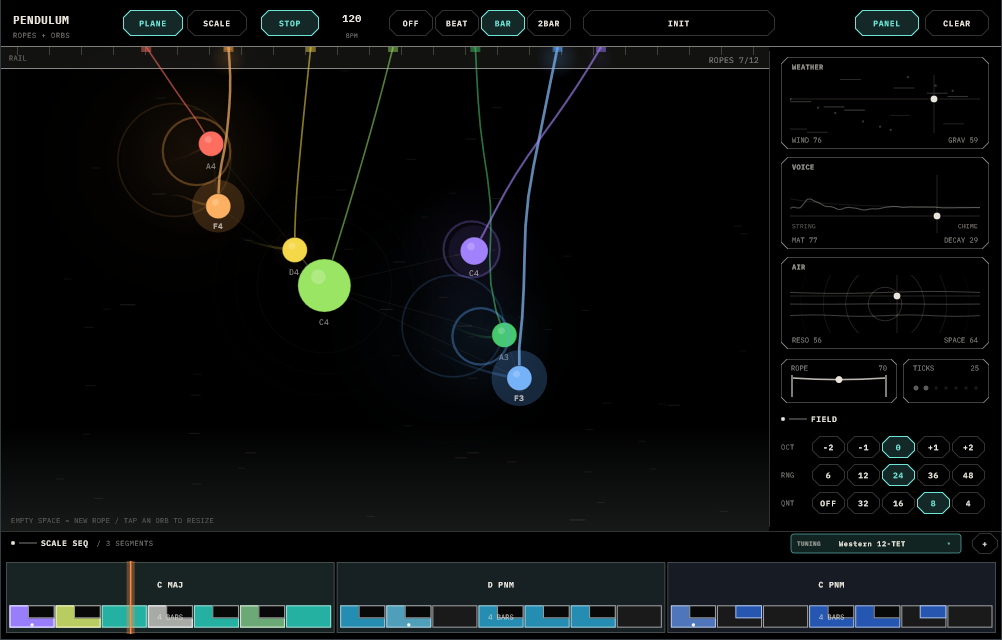
Ropes & Orbs
- Create — press empty space and pull. The anchor snaps to the rail above your press; a dashed preview shows the rope and its note. Release and it's born already swinging along your drag. Direction matters.
- Grab & fling — touch an orb (focus brackets appear), drag, release with motion. Every finger can hold a different orb while others keep creating ropes.
- Slide — drag the small anchor grip on the rail to move a rope sideways without re-creating it.
- Retune — drag the rope body (the line, not the orb) to change its length live. Length is pitch, so this is retuning: the note label follows in real time (
TUNEappears), snapping through the scale. Pull slowly for a physical glissando. - Resize — tap an orb (no drag): it freezes and arms SIZE mode — a ring with a live ×-readout. Drag away from the orb to grow it, toward it to shrink (0.55× to 3×). Tap again, press elsewhere, or wait a few seconds to release it back into the world. A second finger pinches a held orb; the mouse wheel nudges.
- Tear — drag a held orb far past its rope's length: the rope pulls taut, turns amber,
TEARappears — keep pulling and it snaps, falls, and is gone. Weak ropes tear sooner. Tearing is removal, not mute.
Big orbs are heavy: ropes sag under them, they plough through wind, strike louder and darker, and bend the whole field toward themselves. Small orbs flutter, tinkle, and get flicked around.
How Sound Happens
Three physical events make sound; there is no other trigger:
| Event | Cause | Voice |
|---|---|---|
| Strum | An orb sweeps through another rope's body | The struck rope's note — bright, singing, velocity from orb speed |
| Impact | Two orbs collide | Both ropes' notes as a dyad — rounder, with an octave-down sub |
| Tick | An orb reverses at its swing extreme | Its own note — short, damped, quiet (level on the TICKS fader, 0 = off) |
Velocity comes from real impact speed and orb mass; orb size darkens and lengthens the voice. Every event flashes its rope, blooms a ring at the contact point, and lights the scale surfaces.
The Pitch Field
Rope length picks the note — short ropes at the top of the pitch window, floor-reaching ropes at the bottom. The FIELD block defines the window: OCT centres it (±2 octaves), RNG sets its width (6–48 semitones). Inside the window, only in-scale notes exist.
RNG is the personality control. Narrow (6–12): a handful of notes, many ropes in unison, the music becomes motif — a real chime set. Wide (36–48): cascading harp. Every rope carries a few cents of its own drift, so unison ropes shimmer against each other like real neighbouring tubes instead of stacking sterile.
Key changes and OCT/RNG changes re-voice every hanging rope live — the field re-pitches without missing a swing.
Physics
- ROPE — constraint stiffness. High = rods, clean pendulums. Low = bungees: ropes stretch under heavy orbs, periods wobble, collisions squash — and the tear threshold drops.
- GRAV — the tempo of the world. Low = slow lunar arcs; high = fast, busy swings.
- WIND — a gusting horizontal force, offset per rope so the field breathes instead of marching. This is the "keeps playing" control — and it's audible, a quiet band of air rising with the gusts. Orbs catch wind by area over mass: small orbs flutter, giants plough.
- Gravity wells — every orb attracts every other. Between normal orbs it's negligible; inflate one and nearby swings bend toward it — orbits tighten, collisions cluster, and the big orb becomes the gravitational (and tonal) centre. Faint hairlines fade in between orbs as the pull grows.
- PULSE (top bar) — a tempo-synced gust shove at every grid line while the transport runs, direction alternating pulse to pulse. It pumps the swings into the groove the way you'd push a playground swing: ropes whose period matches entrain hard, others syncopate. Works with WIND at zero (pure rhythmic pumping) and pairs beautifully with QNT.
The Sound Engine
- MATERIAL — morphs the voice between two characters: STRING, a plucked harp-like tone, and CHIME, the true windchime — inharmonic, bell-adjacent, with a fresh breath of detune on every strike so no two hits ring identical. Mid-values blend both.
- DECAY — full ring down to tight pluck. The bottom of the range is genuinely percussive.
- RESONANCE — sympathetic ropes: when one rope sounds, the other hanging ropes hum along, strongest at unison, octave, and fifth. The patch layout is the resonator — a dense pentatonic field turns into a sitar-like halo.
- SPACE — the room.
- Everything resonates through a chime-tube body, the vibraphone-tube cousin of the family's other instrument bodies.
Transport & Quantize
The physics is deliberately clock-free — wind and gravity set the groove. The transport drives two things:
- The scale timeline — segments advance in bars (host transport when hosted; PLAY + the BPM chip in standalone).
- QNT — with a grid selected (
1/32 … 1/4), every sound event is held and fired on the next grid line instead of the instant of collision. Free physics + quantized gates = chaotic motion that lands as rhythm. QNT needs a running transport; with it stopped, everything stays free.
Scales, Keys & Other Worlds
The scale strip is always on — the segment timeline is the sole source of truth, one segment minimum (a fresh instance starts in C Pentatonic Minor). Segment chips show each key as a mini keyboard, lit live in the rope colours sounding each note. Tap a chip to edit (root / scale / bars / tap keys for a custom scale); drag an edge to resize; + adds. The SCALE page is the full editor — circle of fifths, per-channel activity, a live output monitor.
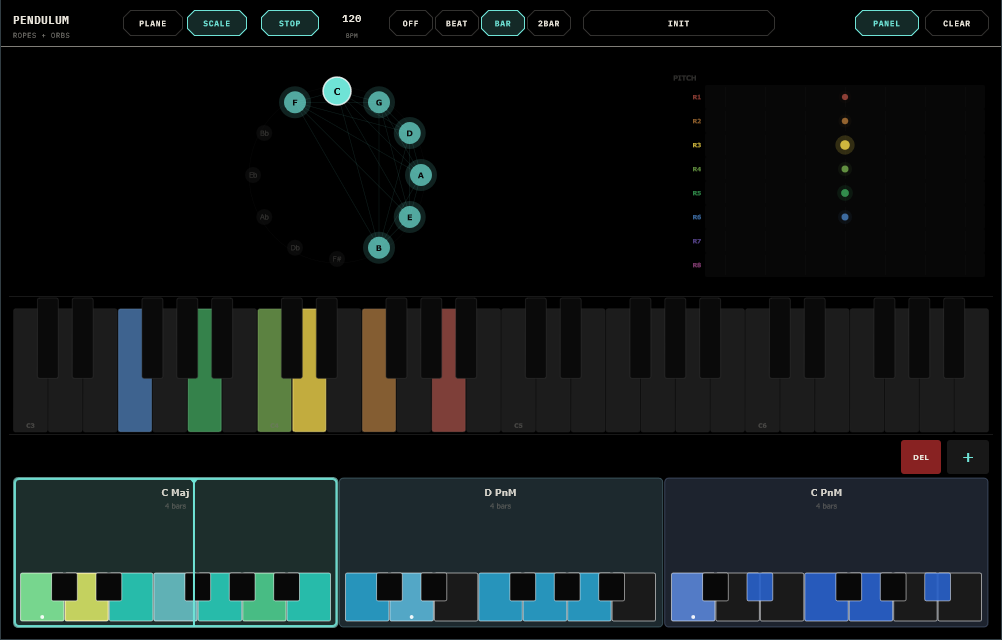
The TUNING chip switches the global intonation — eleven systems, from Western 12-TET through Just Intonation, 24-tone Arabic maqam, 53-comma Turkish makam, 22-shruti, Persian dastgah, and Chinese 12-lü. Rope pitches come from the system's true degrees, and the strip lights per degree. The ropes' natural cent-drift rides on top — in dense systems that reads as extra shimmer, which suits a field of hanging tubes.
Presets
The preset chip opens a browser with folders — tap to load, + SAVE, drag to re-file, rename and delete in place. A preset is the complete patch: ropes (with sizes and drift), physics, sound macros, FIELD, pulse, and the full scale timeline.
Eight factory worlds: Init (clean slate), Porch Chimes (six short tubes in a gentle breeze), Storm Harp (eight ropes, one giant orb, heavy wind), Clockwork (five swing periods of full-level ticks pumped by a BEAT pulse over an Am → Dm → E harmonic-minor timeline), Groove Pump (BAR pulse + 1/8 quantize with a central gravity well), Gravity Well (one 2.8× orb bending a slow lunar field), Music Box (seven tiny tubes an octave up, 1/16 gate), Deep Bells (long heavy tubes two octaves down, breathing every two bars).
The pulse-driven presets want a running transport — press PLAY, or just play your host.
MIDI Out
Tap the PENDULUM title block → Settings → MIDI. Each of the 8 rope colour channels is a track:
- Notes — enable a track and every sound event on that colour sends a note (per-track channel and octave offset, velocity from impact energy, gate scaled by DECAY). Route All collapses everything onto one shared channel.
- CC streams — two independent CC slots per track, each streaming a physics source as a continuous controller: Orb X, Orb Y, Swing Speed, Orb Size, or Wind (the global gust). Change-gated, so still orbs don't flood the wire. CC works with or without notes — a rope can be a pure modulation source.
MIDI settings are rig state, not patch state — your routing survives preset changes. Quantized events send their MIDI on the quantized grid too, so external synths ride the same groove. Try it: one channel's notes to a synth, its CC slots to filter (Orb X) and resonance (Swing Speed) — the pendulum plays and modulates the patch at once.
One honest note: Pendulum doesn't listen to MIDI notes in — the wind doesn't take requests.
Gesture Control
Pendulum listens for CC gestures on channel 1 — a wiimote, or anything CC-shaped, becomes the weather:
| CC | Gesture |
|---|---|
| 22 (hold) + 20/21 tilt | Weather mode — lean the wind with your wrist |
| 24 flick | A single directional gust |
| 23 | Toggle hand mode — a ghost plectrum appears on the plane, steered by tilt, strumming ropes and shoving orbs as it passes |
| 30 | A manual pulse shove, direction alternating |
Weather mode conducts the field; hand mode reaches into it. Both are visible on screen, so the audience sees the invisible hand doing its work.
Settings, Themes & Licensing
Tap the title block: tabs for Settings, MIDI, License, and About. Settings holds five surface themes (Dark, Midnight, High Contrast, Void, Warm), colour presets, and individual swatches for all eight rope channels — the whole instrument repaints, strip and chrome included. Pendulum comes with a 14-day free trial — every feature, no payment details, just an email address to start it. The badge starts it, then counts it down. Before you start it, and after it ends, the demo goes briefly quiet each minute until licensed. The trial and any purchased key both live in the License tab.
Recipes
The porch
MATERIAL 0.9+, RNG 12, DECAY 0.85, RESONANCE 0.5, gentle WIND. Hang six short ropes close together. Walk away.
Wind sequencer
DECAY 0.25, QNT 16, PLAY at ~100 BPM, WIND 40. The gusts write a step sequence.
Gravity-well drone
One rope with a 3× orb, three light ropes around it, WIND 30, RESONANCE high. The giant is the tonal anchor; the small ones orbit and strike it.
Range sweep
While anything plays, walk RNG from 48 → 24 → 12 → 6. The same physics collapses from harp cascade to two-note gong meditation.
Key journey
Build 2-bar segments in the strip (Am pent → F maj → G maj), press PLAY, and let the wind play the progression.
Field Notes
- The physics keeps running with the editor closed — a windy patch keeps playing in your session.
- Everything is saved in host state — reopen a session and the hanging garden returns (ropes restore at rest; the wind re-energizes them).
- Torn ropes are gone. Tearing is removal, not mute — save the patch as a preset before pruning.
- Silent strums are by design — a barely-swinging orb brushing a rope stays quiet; the threshold keeps the field from chattering.
- Max 12 ropes; colours repeat after 8.
- QNT doing nothing? The transport isn't running — quantize needs a grid, and a stopped clock has none.